Last Updated: September 4, 2026
Slip and fall claims fall under premises liability, a branch of tort law holding property owners responsible for unsafe conditions on their land. To prove negligence in a slip and fall, you must establish four distinct legal elements: duty of care, breach of duty, causation, and damages. The burden of proof sits squarely on your shoulders as the plaintiff. Understanding how to prove negligence in slip and fall cases starts with mastering these four pillars before you ever file a claim.
Property owners owe visitors a legal duty to maintain reasonably safe premises. This duty requires them to inspect for hazards, repair dangerous conditions, and warn guests about risks they cannot immediately fix. The standard is reasonable care, not perfection, meaning owners must act as a prudent person would under similar circumstances. A store that fails to mop a spill for hours has likely breached this obligation, while a sudden, unpredictable hazard may not trigger liability.
Establishing breach means showing the property owner knew or should have known about the hazard and did nothing reasonable to address it. Documentation matters enormously here. Photographs of the dangerous condition, maintenance logs showing infrequent inspections, and internal policies about cleaning schedules can all demonstrate that the owner fell short of safety standards. Without visible proof of the hazard, your claim stalls at this element.
Causation requires connecting the property owner's negligence directly to your fall and resulting harm. You must show that the unsafe condition caused your accident and that your injuries flowed naturally from that fall. Proximate cause becomes contentious when pre-existing conditions or intervening factors exist, which is why medical records and a clear timeline are critical to proving negligence in slip and fall claims.
Damages represent the compensation you seek for medical expenses, lost wages, and pain and suffering. Out-of-pocket costs, future treatment estimates, and proof of income loss all build your damages case. Legal guides note that settlement values vary widely based on injury severity and liability clarity, with general settlement valuation guidance helping attorneys assess claim worth. Without documented losses, even a clear liability case produces little compensation.
The moments immediately following a fall determine whether you can prove negligence in slip and fall litigation later. Evidence disappears quickly, witnesses scatter, and surveillance footage gets overwritten, so acting fast is non-negotiable. Your documentation effort in the first hour often outweighs months of attorney work later.
Start by reporting the incident to the property owner or manager and requesting a written incident report. Photograph the hazard from multiple angles, including any warning signs, spill patterns, or defective flooring that caused your fall. Ask nearby customers or employees for their contact information and whether they witnessed the accident. Do not sign anything beyond the incident report, and avoid making statements about how the fall happened until you have spoken with an attorney.
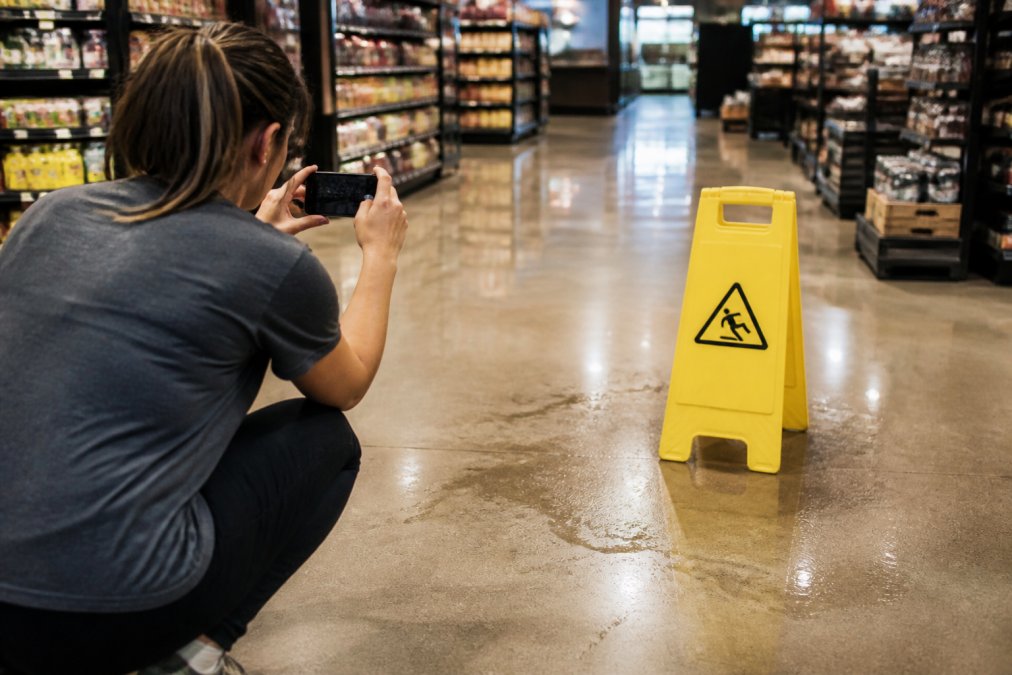
Seek medical attention immediately, even if injuries feel minor, because delayed treatment weakens causation arguments. Request copies of all medical records, diagnostic imaging, and treatment plans, as these documents create the paper trail linking your fall to your injuries. Keep a journal documenting daily pain levels, missed work, and how the injury affects your routine. This contemporaneous record carries significant weight when proving constructive notice in premises liability cases, since it shows the injury's consistent impact over time.
Strong evidence packages combine physical documentation, digital records, and witness accounts to create a complete picture of liability. Current legal practice increasingly depends on surveillance footage and security camera recordings as critical evidence for establishing negligence, according to guidance on evidence in premises liability cases. Building this evidence mosaic requires deliberate effort across several categories.
Photographs of the hazard, measurements of the area, and samples of any substance that caused your fall all qualify as physical evidence. Preserve torn carpet, cracked tiles, or the actual liquid from the spill if possible. These items prove the dangerous condition existed and demonstrate the property owner failed to maintain safety standards.
Request surveillance footage in writing immediately, since many businesses overwrite recordings within days or weeks. Send a preservation letter to the property owner demanding they retain all video evidence related to your fall. Digital evidence also includes maintenance logs, inspection reports, and employee training records that reveal whether the owner followed proper safety protocols.
Eyewitness accounts corroborate your version of events, so collect names and phone numbers at the scene. Expert witnesses add another layer by testifying about industry safety standards, slip resistance testing, or the property owner's deviation from accepted practices. These experts help explain complex technical issues to a jury in clear, persuasive terms.
Notice is often the battleground in slip and fall claims because property owners argue they had no knowledge of the hazard. Understanding the distinction between actual and constructive notice determines whether you can prove negligence in slip and fall cases where no one saw the property owner become aware of the danger. Constructive notice is not about what the owner knew, it is about what a reasonable owner should have discovered through proper inspection and maintenance.
Actual notice means the property owner or an employee directly observed the hazard or received a report about it. A customer complaint to a manager, a work order describing a wet floor, or an employee's observation of a spill all constitute actual notice. Constructive notice, by contrast, exists when the hazard was present long enough that a reasonable property owner conducting ordinary inspections would have discovered it, even if no one explicitly reported it.
The critical distinction matters because actual notice is straightforward to prove, you need testimony or documentation showing the owner knew. Constructive notice requires you to establish a timeline proving the hazard existed for a sufficient duration. Courts do not impose a fixed time threshold; instead, they ask whether the owner's inspection schedule was reasonable and whether the hazard would have been visible during a routine inspection. improving floor traction.
Most courts apply a "duration test" to constructive notice: the longer a hazard remains visible and unaddressed, the more likely a jury will infer the owner should have discovered it (peer-reviewed research). A spill that exists for 15 minutes may not trigger constructive notice if the owner inspects floors hourly. A spill that sits for four hours almost certainly does, especially in a high-traffic retail environment where frequent inspections are standard practice.
Gather evidence about the property owner's inspection frequency and practices. If you fell on a grocery store floor, request the store's cleaning schedule and ask whether staff conduct floor checks every 30 minutes, hourly, or less frequently. If the store's own policy requires inspections every hour but the hazard existed for three hours, you have strong constructive notice evidence. Witness testimony about how long the hazard was visible before your fall becomes critical, ask bystanders whether they saw the spill or defect for minutes or hours before you fell.
Photographs and video footage help establish duration indirectly. If security camera footage shows the hazard present 30 minutes before your fall, and the property owner's inspection logs show no floor check during that window, constructive notice is established. Similarly, if multiple customers or employees testify they noticed the hazard at different times throughout the day, the cumulative timeline proves the hazard existed long enough for discovery.
Constructive notice also depends on whether the property owner's inspection practices met industry standards. A retail store in a busy shopping mall should inspect floors more frequently than a quiet office building. A restaurant with a bar and food service should check for spills constantly; a law office may inspect once daily. Expert witnesses, safety engineers or premises liability consultants, can testify about what inspection frequency is reasonable for the specific property type and use.
Request the property owner's written safety policies and inspection logs. If the owner's own policy requires hourly floor checks but logs show inspections only occurred twice that day, the owner breached its own standard. This is powerful evidence of constructive notice because it shows the owner knew what reasonable inspection looked like but failed to follow through.
Courts also examine whether the hazard was foreseeable, meaning a reasonable owner would anticipate the risk based on the property's use. A grocery store with a history of produce spills should have protocols for frequent floor checks and spill cleanup stations. A restaurant with a wet bar should expect water and liquid hazards. A parking garage should anticipate water from rain and snow. If the property owner knew the hazard was likely to occur but failed to implement preventive measures or frequent inspections, constructive notice is easier to establish.
Gather evidence of prior similar incidents. If other customers fell in the same location previously, or if employees reported spills in that area multiple times, you can argue the owner had notice the location was hazard-prone and should have increased inspection frequency. Incident reports, customer complaints, and prior injury claims all support a foreseeability argument.
Be cautious about admissions you make immediately after falling. If you tell a manager "I didn't see the spill" or "I should have been watching where I was going," these statements can be used against you to argue you were negligent and the hazard was obvious. Similarly, avoid saying you saw the hazard before falling but thought you could navigate around it, this shifts fault to you because you arguably failed to take reasonable steps to avoid it. Stick to factual descriptions: "I fell on a wet floor," "There was no warning sign," or "I did not see the hazard before I fell." Let your attorney handle detailed explanations of notice and fault.
Tennessee imposes a strict deadline for filing personal injury claims, including slip and fall lawsuits. Missing this window means losing your right to recover compensation entirely, regardless of how strong your evidence is. The exact time limit depends on the specific claim type and circumstances, so verifying the current deadline with an attorney is essential before proceeding. Acting promptly protects your claim and ensures critical evidence remains available.
Tennessee follows a comparative fault system, meaning your compensation decreases by the percentage of fault assigned to you. If you were texting while walking and failed to notice a clearly visible hazard, the court may find you partially responsible. This is where honest evidence collection matters, because inconsistencies in your story can inflate your fault percentage and reduce your recovery.
Before pursuing litigation, organize your evidence, calculate your full damages, and understand the claims process. Many premises liability cases resolve through negotiation rather than trial, but insurance companies respond to well-documented demands backed by credible evidence. Cummings Law Car Accident & Personal Injury Lawyers has recovered over $47,000,000.00 for clients by building precisely these kinds of evidence packages and negotiating aggressively with insurers. Our team operates on a contingency fee basis, meaning you pay no fees unless we win your case, and we handle everything from evidence collection to settlement discussions under Tennessee law.
The path to proving negligence in slip and fall cases demands thorough documentation, an understanding of legal notice requirements, and strategic evidence preservation. Acting quickly after your accident gives you the strongest chance at fair compensation for medical expenses, lost wages, and property damage.
Proving negligence in a slip and fall requires more than just telling your story, it demands a complete evidence package that satisfies every legal element. Cummings Law Car Accident & Personal Injury Lawyers brings experience navigating Tennessee premises liability claims, recovering over $47,000,000.00 for injured clients. We handle evidence preservation, expert witness coordination, and insurance negotiations on a contingency basis, so you pay nothing unless we win. Get started with Cummings Law and let us build the case that secures the compensation you deserve.
To prove negligence in a slip and fall, you must establish four elements: duty of care (the property owner's legal obligation to maintain safe premises), breach of duty (the owner failed to address a hazard), causation (the breach directly caused your fall), and damages (you suffered measurable injuries or losses). Each element must be proven to hold the property owner liable. Without all four, your claim may fail even if you were injured.
You can prove notice in two ways. Actual notice means the owner directly knew about the hazard. Constructive notice means the hazard existed long enough that a reasonable property owner should have discovered it through normal maintenance and inspections. For example, a spill left unattended for hours, or a broken step that wasn't repaired for weeks, can establish constructive notice. Surveillance footage, maintenance records, and prior complaints all support this.
In Tennessee, you generally have one year from the date of your injury to file a premises liability lawsuit. Missing this deadline bars your claim entirely. However, exceptions exist in limited circumstances, such as when the injury wasn't immediately apparent. Because this timeline is strict and unforgiving, consult an attorney promptly after your accident to protect your legal rights.
The most critical evidence includes surveillance footage from the property, photographs of the hazard and scene, your medical records documenting the injury, incident reports filed with the property owner, and witness statements. Digital evidence like security camera recordings is increasingly relied upon by courts to establish what happened. Preserve all evidence immediately, the longer you wait, the more likely it disappears or becomes degraded.
This article was written using GrandRanker

Cummings Law Car Accident & Personal Injury Lawyers Address: 4235 Hillsboro Pike #300, Nashville, TN 37215