Last Updated: September 27, 2026
Lost wages after a car accident are the income you would have earned if your injuries had not kept you out of work, and you will need solid records to prove lost wages. They are recoverable as part of your compensatory damages, alongside medical bills and other losses. (Source: guidance from the U.S. Department of Labor)
The evidence that proves a wage claim usually falls into four buckets. According to legal guidance on lost wage claims, claimants typically rely on employer statements, financial records, timesheets, and medical records working together. No single document wins on its own.
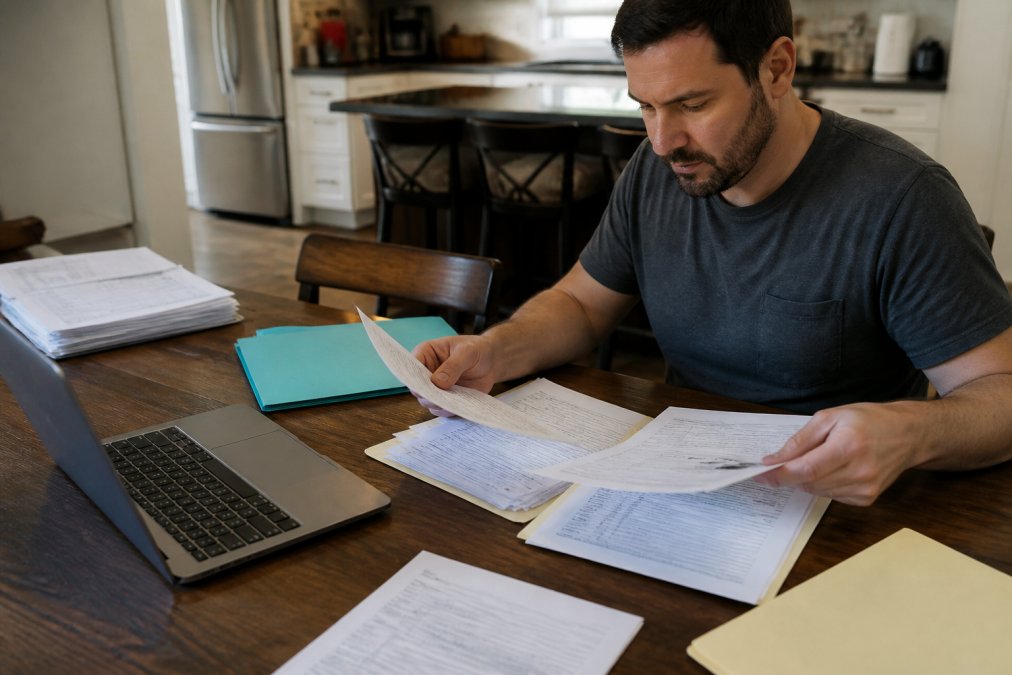
Here is what to gather:
Medical proof is the piece most people underestimate. A law firm guide to proving lost wages notes that pay stubs and employer letters alone are not enough. You also need a physician's note that states you could not work, or that you were placed on work restrictions.
Ask your doctor to put it in writing:
Here is a template your employer can use:
[Company Letterhead]
Date: __________
To Whom It May Concern,
This letter confirms that [Employee Name] is employed with [Company Name] as a [Job Title]. [Employee Name] earns [pay rate] per [hour/week/year].
Due to injuries sustained in a motor vehicle accident on [date of accident], [Employee Name] was unable to work from [start date] to [end date]. This resulted in [number] missed workdays and an estimated loss of [amount] in gross income.
[Employee Name] was also scheduled for [overtime/shifts] during this period.
Please contact me at [phone/email] with any questions.
Sincerely,
[Supervisor Name], [Title]
Self-employed workers, independent contractors, and gig workers face a harder road. With no employer to sign a verification letter, you must build the paper trail yourself, and translate irregular income into a number an adjuster will accept.
Pull two to three years of records if you have them. One year is the minimum most adjusters accept; three years smooths out seasonal swings and one-off windfalls.
An average is only half the argument. You also need to show that work was on the calendar.
If you run a cash-heavy business, your tax returns matter more, not less. They are the cleanest proof of what you actually earned and the document an adjuster trusts most because they carry legal weight. If your returns show less income than you actually took in, you have a credibility problem no bank statement will fix. Be honest about it with your attorney early. (Source: guidance on calculating lost wages)
If your injury limits how much you can work going forward, fewer hours, fewer clients, or a type of work you can no longer perform, that is lost earning capacity, not just lost wages. It requires a vocational expert, an economist, or both. Flag it early so your attorney can build that part of the claim before the statute of limitations runs.
Your paycheck is not the whole claim. Bonuses, commissions, and benefits count too, but each needs its own proof.
| Loss Type | How to Prove It | What to Gather |
|---|---|---|
| Paid time off | Payroll records | PTO balance before and after |
| Sick leave | Employer records | Days used due to injury |
| Bonus | Prior payouts | Bonus history and plan terms |
| Commission | Sales records | Deals lost during recovery |
| Health benefits | Plan documents | Employer contribution amount |
| Retirement match | Payroll records | Missed 401(k) contributions |
A denial is not the end of the claim. It is usually a negotiating position, often reversible if you respond with the right documents in the right order.
Adjusters deny wage claims for predictable reasons:
Ask the adjuster to put the reason in writing. A verbal denial is easy to walk back and hard to appeal; a written denial forces the insurer to commit to a position and tells you exactly which gap to fill.
Match your response to the stated reason. Do not send a shoebox of documents and hope something lands.
If the adjuster still refuses, send a formal demand letter with a chronological summary of the accident, medical treatment, work restrictions, lost income calculation, and supporting documents. Send it certified mail with return receipt, and keep a copy.
If the adjuster will not move after a documented demand, that is the point to bring in a lawyer. Cummings Law Car Accident & Personal Injury Lawyers handles these disputes for injured people across Middle Tennessee and works on a contingency fee basis, meaning you pay no fees unless the case is won.
The biggest mistake is treating wage loss as an afterthought. People document medical care carefully, then hand over a vague estimate of missed work. That gap costs real money.
Watch for these:
The at-fault driver's insurance company typically pays for lost wages as part of a personal injury claim. If the at-fault driver is uninsured or underinsured, your own uninsured/underinsured motorist coverage may apply. In Tennessee, you can also pursue a direct claim against the at-fault driver. An experienced attorney can help you identify all available sources of compensation and negotiate with the insurance adjuster to ensure your lost income is fully accounted for.
The core documentation includes recent pay stubs, W-2 forms, and prior tax returns to establish your income level. You will also need an employer verification letter confirming your rate of pay and specific dates of missed work, plus timesheets or work schedules. Medical records or a doctor's note linking your injuries to your time off work are essential. Bank statements showing direct deposits can further corroborate your income. Gathering these documents early strengthens your claim and speeds up settlement negotiations.
Yes, self-employed individuals can claim lost wages, but the documentation differs. You will typically need profit-and-loss statements, 1099 income records, business and personal tax returns, invoices, and bank statements showing consistent revenue. A letter from a CPA or accountant verifying your typical income and the specific jobs or contracts you missed due to the accident is also helpful. Because income can fluctuate, having a professional calculate lost income for self-employed accident victims is important to present a credible claim.
Yes, a doctor's note or medical records are critical. The note should explicitly state that your accident-related injuries required you to miss work or follow specific work restrictions. This creates the medical necessity link between your injuries and your lost income. Without medical documentation, the insurance adjuster may argue you could have worked. Keep copies of all treatment records, discharge instructions, and any written work restrictions your physician provides throughout your recovery.

Cummings Law Car Accident & Personal Injury Lawyers Address: 4235 Hillsboro Pike #300, Nashville, TN 37215