Last Updated: November 11, 2026
Quick Summary
Wet and greasy floors are the most cited cause of slip and fall accidents in businesses, followed by uneven flooring, loose mats, cluttered walkways, poor lighting, unsafe stairs, and outdoor hazards like rain, snow, and ice. Most of these hazards come from routine work such as mopping, spills, leaks, and grease buildup, and each one is a condition someone controls.
Slip and fall accidents in businesses happen when a walking surface, a walkway, or the surrounding environment fails the person using it. In premises cases, the key question is often whether the property owner knew, or should have known, about the hazard. (Source: research on nonfatal occupational injuries from slips and falls)
The research is clear on the mechanics. A peer-reviewed study on slips, trips, and falls identifies inappropriate floor materials, slippery surfaces, poor lighting, and inadequate footwear as the core factors behind these accidents. Notice what that list has in common: every item is a condition someone controls.
The three events differ, and the distinction matters for prevention and proof.
Why does the distinction matter? Because each one points to a different hazard and a different fix. Slips point to wet or greasy surfaces. Trips point to clutter, uneven edges, and raised thresholds. Falls from height point to stairs, ladders, and missing handrails.
Federal workplace data backs up the injury side. According to research on nonfatal occupational injuries from slips and falls, sprains and strains were the most common fall injury over a three-year period, and most followed a slip event. That pattern holds for customers and visitors too.
Wet and greasy floors are the most cited cause of slip and fall accidents in businesses and the easiest to prevent. Water, cleaning solution, cooking oil, and tracked-in rain all cut the friction a shoe needs to grip.
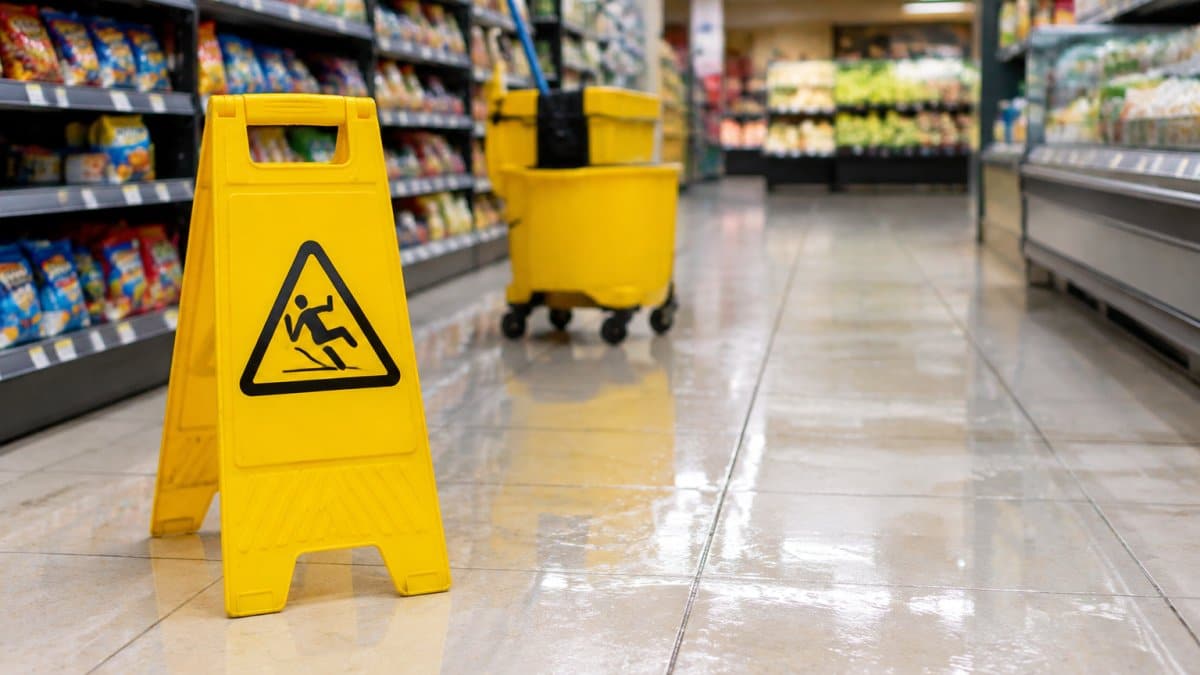
Where do these hazards come from? Most often from routine work:
A wet floor sign warns; it does not remove the hazard. The fix is a drying pass, absorbent mats at entrances, and a spill response any employee can start in seconds.
Uneven flooring, loose mats, and cluttered walkways cause trips that end in hard falls, and they are the hazards most often overlooked during a busy shift. A raised tile edge of a few millimeters is enough to catch a toe.
Watch out: loose mats are a double hazard. A curled mat edge creates a trip point, and a mat that slides on a smooth floor creates a slip point. Either one can send a visitor down.
The usual culprits include:
An inspection routine catches these first. Walk the floor at opening, shift change, and closing; fix what you find or mark it and block it off.
Poor lighting, unsafe stairs, and outdoor conditions extend slip and fall risk beyond the sales floor. Visibility is the link: a person who cannot see a step edge, curb, or patch of ice cannot avoid it.
Stairways deserve their own checklist. Look for:
Outdoor walkways and parking areas bring seasonal risk. Rain, snow, and ice turn smooth concrete into a slipping surface, and cracked pavement creates trip points that stay dangerous after the weather clears.
The causes of slips, trips, and falls in the workplace shift by industry and location, so a single generic checklist rarely fits.
| Business Type | Top Hazard | Where It Shows Up | Why It Happens There |
|---|---|---|---|
| Grocery and retail | Spills and wet floors | Aisles, entrances, produce misters | Mist from produce cases, leaking coolers, and carts tracking in rain |
| Restaurants and food service | Grease and wet floors | Kitchens, dish stations, dining room | Fryer splash, dish spray, and mopping during service |
| Warehouses and logistics | Clutter and uneven flooring | Loading docks, aisles, walkways | Pallets, shrink wrap, dock plates, and forklift traffic |
| Offices | Loose mats and cables | Entrances, hallways, server rooms | Entry mats that curl, power cords, and polished hard floors |
| Hospitality | Wet floors and stairs | Lobbies, pool decks, stairwells | Pool splash, luggage carts, and guests in wet footwear |
| Healthcare | Spills and obstructed paths | Corridors, patient rooms, entrances | Fluid spills, equipment cords, and high foot traffic |
A few setting-specific patterns are worth calling out because they drive most claims.
Restaurants. The kitchen is the highest-risk room.
Warehouses and logistics. The hazard here is usually a trip, not a slip.
Offices. Offices look low-risk, so hazards linger: a curled entry mat, a power cord run across a hallway, a freshly polished lobby floor.
Hospitality. Lobbies and pool decks combine water with smooth, often polished surfaces. Because freshly cleaned tile can remain slick under wet shoes, clear warnings and coordinated cleaning practices help reduce exposure, a concern Guso Janitorial Services addresses through its focus on cleaning-crew safety.
Healthcare. Corridors carry patients, visitors, and staff at once, often with equipment on wheels.
Higher-risk visitors deserve extra attention.
Slip and fall accident prevention for businesses works best as a system, not a one-time cleanup: inspection, cleanup response, training, and documentation. Each part needs a named owner and a written standard, because a hazard everyone is responsible for is a hazard no one fixes.
A workable inspection routine covers every walking surface a customer or visitor can reach, plus the paths employees use to get there. A routine that includes several walks a day can help catch many transient hazards:
A hazard log should record the date and time, location, what was found, who reported it, what was done, and when it was resolved. That shows a business took reasonable care and creates a record an injured visitor can rely on.
A spill response standard should name a target time from report to cleanup. Businesses commonly treat spills in customer areas as a priority and block the area off until the surface is dry.
Watch out: a wet-floor sign is not a cleanup. It warns but does not remove the hazard, and a sign left out after the floor is dry trains customers to ignore signs. Do a drying pass so the sign comes down as soon as the surface is safe.
Training should cover four things: recognizing a hazard, reporting it, starting a cleanup, and appropriate footwear. Staff in kitchens, dish rooms, and warehouses benefit from slip-resistant footwear. Every employee should know where the nearest spill kit is and how to use it without waiting for a manager.
Keep dated, named records of inspections, repairs, incidents, and training, and review the log on a schedule so recurring hazards get fixed at the source. A mat that curls weekly, a cooler that leaks monthly, and a step edge that chips repeatedly are maintenance problems, and the log is how a business spots the pattern.
What to do after a slip and fall at a business comes down to four steps: get medical care, report the incident, document the scene, and preserve evidence. Do them in that order if your health allows.
If you fell in a store, our guide on grocery store slip and fall steps walks through the specific next steps for that setting.
Protecting your rights after a business injury starts with understanding what you must prove.
Tennessee law governs these claims, and the rules on notice, comparative fault, and filing deadlines can affect a case's value. Compensation depends on medical expenses, lost wages, and injury severity; our guide on slip and fall injury compensation explains that calculation and the evidence that supports it.
Choosing the right lawyer matters as much as the facts. Our page on how to find the best slip and fall lawyer covers the questions to ask before you hire anyone.
A fall on a business premises can leave you with medical bills, missed work, and a long recovery. Cummings Law Car Accident & Personal Injury Lawyers handles these claims across Middle Tennessee.
The most frequent causes are wet or greasy floors, spills and leaks, uneven or damaged flooring, cluttered walkways, loose mats, and poor lighting. Stairs without secure handrails and outdoor surfaces affected by rain, snow, or ice add to the risk. Research on workplace falls has found that sprains and strains are among the more common injury types, and that many follow a slip event. Property owners and employers are responsible for identifying and correcting these hazards.
Slip and fall accident prevention for businesses starts with a routine inspection system. Check floors for moisture, damage, and debris at set intervals, clean spills immediately, and place warning signs while floors dry. Secure or replace loose mats and rugs, repair cracked pavement and loose floorboards, and keep walkways clear. Improve lighting in stairwells, entrances, and parking areas, and require safe footwear in kitchens and warehouses. Document each inspection so you can show a consistent safety practice.
Report the incident to a manager immediately and ask for a written report. Photograph the hazard, your injuries, and the surrounding area before anything is cleaned or moved. Collect names and contact details from witnesses and keep the shoes and clothing you were wearing. Seek medical attention the same day, even if you feel fine, and keep every record. Then speak with a personal injury lawyer before giving a recorded statement to an insurance company.
It depends on the severity of your injuries, the evidence that the property owner knew or should have known about the hazard, and the losses you can document. Medical bills, lost wages, and ongoing treatment often justify a claim. A consultation with a personal injury lawyer helps you understand whether your case is worth pursuing. Cummings Law works on a contingency fee basis, so you pay no fees unless the case is won.

Cummings Law Car Accident & Personal Injury Lawyers Address: 4235 Hillsboro Pike #300, Nashville, TN 37215