Last Updated: September 20, 2026
Accident victims who hire professional legal counsel receive, on average, 3.5 to 4.4 times more compensation than those who handle claims alone, according to Mike Payne Law's 2026 settlement comparison. That gap is the clearest argument for hiring a personal injury lawyer after a bicycle crash. At Cummings Law Car Accident & Personal Injury Lawyers, we've seen how quickly that gap closes when a cyclist has someone negotiating on their behalf.
The numbers here aren't subtle. According to [Rev.com's 2026 personal injury(/tag/tennessee-injury-attorneys/) statistics | rev.com], plaintiffs who hire lawyers receive over 4.4 times more compensation on average than those who go it alone.
That multiplier holds even in modest cases.
Insurers price risk. When a claim arrives without an attorney attached, the carrier treats it as low-risk and offers accordingly.
Tennessee follows a modified comparative fault system. If you are found to share fault for the crash, your recovery is reduced by your percentage of fault, and you recover nothing if that share reaches 51% or more. That single rule shapes every bicycle accident claim in the state, because drivers and their insurers almost never concede 100% fault to a cyclist.
Adjusters build a fault argument from a small set of recurring themes. In bicycle cases, the usual ones are:
The counter is evidence, gathered early and mapped to each argument the carrier raises:
A quick illustration of how comparative fault changes the payout:
| Fault Assigned to Cyclist | $100,000 Claim Value | Your Recovery |
|---|---|---|
| 0% | Full value | $100,000 |
| 20% | Reduced by 20% | $80,000 |
| 40% | Reduced by 40% | $60,000 |
| 51% or more | Barred from recovery | $0 |
A driver in a car-versus-car crash is protected by the vehicle; a cyclist is not. Insurers know a jury may sympathize with a driver who says the cyclist was hard to see, and they price that sympathy into the opening offer. A lawyer's job is to anchor the fault question to the driver's duty of care, to look, to yield, to pass at a safe distance, rather than to the cyclist's clothing or lane position.
Most bicycle accident claims settle without a courtroom. The average personal injury claim takes about 11.4 months to resolve, per Rev.com's 2026 data, and the cases that resolve fastest are the ones with the cleanest evidence.
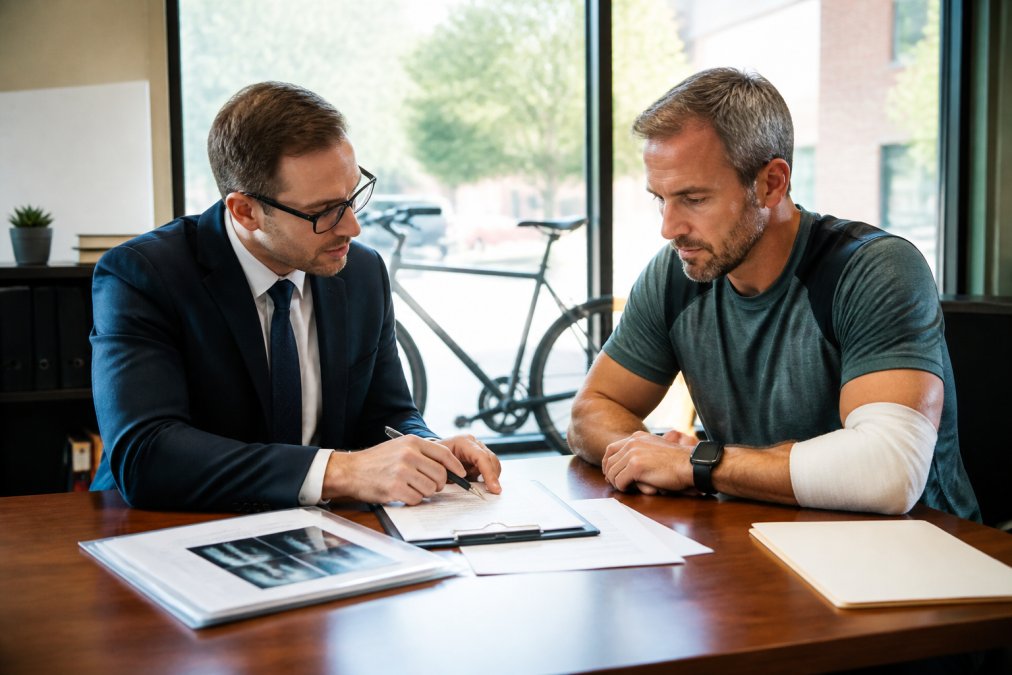
Evidence disappears fast after a crash. Skid marks fade, surveillance footage gets overwritten, and witnesses become hard to reach.
Adjusters are trained negotiators; you are not. A common mistake is giving a recorded statement before understanding how it will be used, those statements get mined for admissions about speed, lane position, or prior injuries. Your lawyer handles that communication so nothing you say gets repurposed against you.
Tennessee's personal injury statute of limitations sets a firm deadline for filing suit, and missing it generally bars your claim entirely. Because the deadline is set by statute, confirm the current filing window for your case with an attorney or the official court source rather than relying on a general figure. The practical point is simpler: evidence and witness memory degrade with time, so waiting months to consult a lawyer usually costs more than it saves.
Bicycle crashes follow different physics than car crashes, which changes who is liable, what evidence matters, and how fault gets apportioned. Treating a bike crash as a car crash with a different vehicle misses the three issues that decide bike cases.
A cyclist has no crumple zone, seatbelt, or airbag, the rider's body absorbs the impact. Two consequences shape the legal case:
"Dooring" is when a driver or passenger opens a car door into a cyclist's path, one of the most common urban bicycle crash types, and one of the most misunderstood. The legal question is not just who opened the door, but:
Bike lane collisions raise a separate set of questions that do not exist in car-versus-car cases:
Insurers know bicycle cases are fact-specific, and that a cyclist who cannot explain the physics, lane configuration, or door-opening sequence is easy to lowball. The reverse is also true: a claim arriving with a reconstruction, a preserved dashcam, and a clear liability theory against the right defendant gets taken seriously.
A personal injury lawyer is a legal professional who manages an injury claim from investigation through settlement or trial, handling evidence, negotiations, and court filings on the claimant's behalf.
In practice, that means:
Most bicycle accident attorneys work on a contingency fee basis, meaning the fee comes out of the recovery rather than your pocket upfront. If the case recovers nothing, you typically owe no attorney fee.
There is no single figure because every case depends on injury severity, medical costs, lost income, and fault. A lawyer evaluates your specific damages, including future medical treatment, pain and suffering, and lost earning capacity, then builds a claim that reflects the full impact of your injuries.
Tennessee law sets a deadline for filing personal injury lawsuits, and missing it can bar your claim entirely. Because the statute of limitations is a strict filing deadline, you should speak with an attorney as soon as possible after a bicycle accident. An experienced lawyer can confirm the applicable deadline for your situation and ensure all required filings are submitted on time. Waiting even a few weeks can complicate evidence gathering and witness availability.
Comparative fault laws in Tennessee reduce your recovery by your percentage of fault. If a court finds you 20% responsible for the crash, your compensation is reduced by 20%. Tennessee follows a modified comparative fault rule, meaning you can recover damages only if you are less than 50% at fault. An attorney gathers evidence, such as witness testimony and accident reconstruction, to counter claims that you shared blame and to protect your maximum recovery.
With a contingency fee, you pay no upfront costs. The attorney's fee comes out of the settlement or court award only if the case succeeds. Cummings Law operates on this model, so there are no hourly charges or retainer fees. If the case does not result in recovery, you owe no attorney's fee. This arrangement aligns the lawyer's interests with yours and removes the financial barrier that might otherwise prevent you from seeking representation.
A bicycle crash leaves you recovering from injuries while an insurance adjuster works the phones. Cummings Law Car Accident & Personal Injury Lawyers handles that negotiation, protects your rights under Tennessee law, and pursues compensation for medical expenses, lost wages, and property damage, all with no fees unless the case is won. Get started with Cummings Law Car Accident & Personal Injury Lawyers and let someone else carry the legal weight for a change.

Cummings Law Car Accident & Personal Injury Lawyers Address: 4235 Hillsboro Pike #300, Nashville, TN 37215