Last Updated: August 17, 2026
Your first 48 hours after discovering a medical malpractice injury are critical. What you do now, and what you document, will shape everything that follows, from your recovery to your legal claim. This guide from Cummings Law Car Accident & Personal Injury Lawyers covers the essential actions to take after a medical malpractice injury to protect both your health and your legal rights.
If you're experiencing a serious adverse reaction or worsening condition after medical treatment, seek emergency care immediately. Call 911 or go to the nearest emergency room. Your health comes first, and this medical visit creates an official record of the problem, a critical piece of evidence for your case later.
When you arrive at the emergency department, tell the medical team exactly what happened during your previous treatment. Be specific: the date, the procedure, the symptoms that appeared afterward, and any warnings you were or weren't given. Ask for copies of all new test results, imaging, and notes before you leave. Request that the medical record clearly document your complaint about the prior treatment. This creates a documented timeline linking your injury to the original medical error.
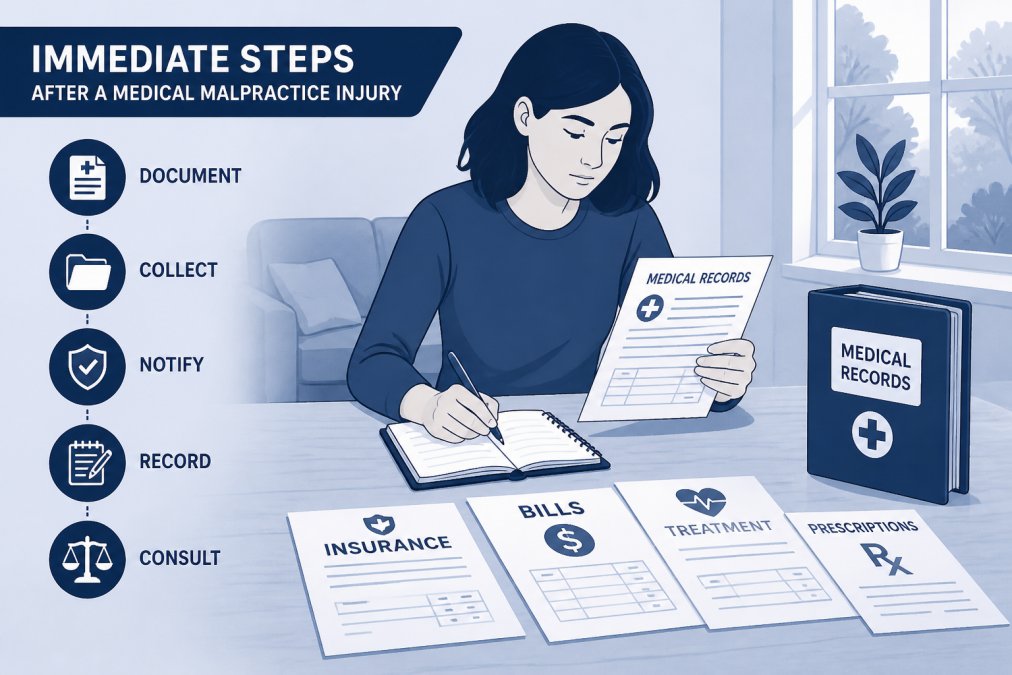
Start a detailed written record immediately. Include dates, times, names of healthcare providers involved, specific symptoms you're experiencing, and how the injury is affecting your daily life. Don't rely on memory, write it down while details are fresh. This contemporaneous documentation carries significant weight in medical malpractice litigation.
Take photographs of any visible injuries. If you're experiencing complications like infection, scarring, or other physical manifestations, photograph them regularly with date stamps. Store these images securely and make backup copies. Photographs provide visual evidence that's often more persuasive than descriptions alone.
Evidence preservation is non-negotiable in medical malpractice cases. Once you suspect negligence, you have a legal duty to preserve all evidence related to your injury. Failure to preserve evidence can harm your claim significantly.
Request your complete medical records from every provider involved in your care. Include records from the original treatment, any follow-up visits, emergency room visits, and specialist consultations. Many healthcare providers will charge copying fees, typically between $0.50 and $2 per page, though this varies by state and facility.
When you receive your records, review them carefully for inconsistencies, missing entries, or notes that contradict what you were told. Look for gaps in documentation, procedures that aren't properly documented, missing informed consent forms, or incomplete surgical notes. These gaps often reveal negligence. Keep all records organized chronologically and store them safely. You'll need them for your attorney and potentially for expert review.
If your injury involved a medical device, medication, or surgical instrument, preserve it if possible. Don't use or discard anything related to your treatment. Defective medical devices or contaminated medications may be central to proving your case. Similarly, keep all correspondence from the healthcare provider or hospital, emails, letters, billing statements, anything related to your care.
If your treatment involved surgery or a procedure, the surgical specimens or removed tissue may still be preserved at the hospital. Request that these be retained and not destroyed. Your attorney can subpoena them if necessary, but it's better to ensure preservation immediately.
The statute of limitations is a legal deadline. Miss it, and you lose your right to sue, regardless of the strength of your case. Understanding this deadline is essential.
In most states, the medical malpractice statute of limitations is two to three years from the date you discovered the injury or should have discovered it. This is called the "discovery rule." However, some states have absolute caps, typically five to ten years from the date of the negligent treatment, after which no lawsuit can be filed, even if you just discovered the injury.
Tennessee's statute of limitations for medical malpractice is generally one year from the date of discovery of the injury, with some exceptions. Because these rules are complex and vary by state and circumstance, consult with a legal professional immediately. Don't assume you have years to file. Many people lose viable claims by waiting too long.
Proving medical negligence requires establishing four specific elements. All four must be present for a successful claim.
Medical negligence begins with a breach of duty. A healthcare provider owes you a duty to provide care that meets the standard of care, the level of care a reasonably competent provider would have given under similar circumstances. When a provider falls below that standard, they've breached their duty.
Proving a breach of duty typically requires expert testimony. An expert witness, another physician or medical professional in the same field, must testify that the defendant's actions deviated from the standard of care. For example, if a surgeon failed to check for a known contraindication before prescribing medication, an expert would testify that this deviation from standard practice constitutes a breach.
Documentation is crucial here. Medical records that show what was and wasn't done provide the foundation for expert testimony. Your attorney will work with medical experts to review your records and identify where the standard of care was violated.
Proving that the breach caused your injury is called establishing causation. The defendant's negligence must have directly resulted in your harm. This requires showing a clear causal link: the provider's action (or inaction) led to your injury.
Damages are the measurable harms you've suffered. These include medical bills from treating the injury, lost wages from time away from work, physical pain and suffering, and emotional distress. In cases of permanent disability or wrongful death, damages can be substantial.
Your attorney will gather evidence of damages: medical invoices, pay stubs showing lost income, testimony from family members about changes in your quality of life, and expert testimony about future medical needs or lost earning capacity. The stronger your documentation of damages, the stronger your claim's value.
To pursue a medical malpractice claim, you must meet specific legal requirements. Most states require a certificate of merit or affidavit from a medical expert stating that the defendant's care fell below the standard of care and caused your injury. This requirement exists to prevent frivolous lawsuits.
Your attorney must file this certificate before or shortly after filing your lawsuit. Without it, your case can be dismissed. This is why consulting with a legal professional early is so important, they'll ensure all procedural requirements are met and evidence is properly preserved.
Additionally, some states require that you notify the healthcare provider in writing of your intent to sue before filing the lawsuit. This notice period typically ranges from 30 to 90 days. Your attorney will handle these notifications and ensure compliance with all state-specific requirements.
This is where the path forward becomes clearer. An experienced medical malpractice attorney understands the complex intersection of medicine and law. They know how to evaluate whether your case is viable, what evidence is most persuasive, and how to navigate the litigation process.

Most medical malpractice attorneys offer free initial consultations. Bring all your medical records, documentation of your symptoms and injuries, and a timeline of events. Be prepared to discuss what happened, when it happened, and how it's affected you.
Your attorney will ask detailed questions about your medical history, the treatment you received, and what went wrong. They'll explain whether your situation meets the legal elements of medical negligence and what your case might be worth. They'll also discuss the litigation process, timelines, and their fee structure.
At Cummings Law Car Accident & Personal Injury Lawyers, consultations are confidential and obligation-free. The firm works on a contingency fee basis, meaning you pay no legal fees unless they win your case or secure a settlement. This aligns the attorney's interests with yours, they only make money if you recover compensation.
Medical malpractice litigation takes time. Cases often take one to three years from filing to resolution, sometimes longer if the case goes to trial. During this period, medical bills may continue to mount, and lost income may create financial hardship.
Discuss with your attorney the possibility of a settlement advance or litigation loan. These aren't free, they carry interest and fees, but they can help bridge the financial gap while your case progresses.
Additionally, ask your attorney about negotiating payment plans with medical providers treating your ongoing condition. Many hospitals and clinics will work with you if they know a settlement is pending. Your attorney may be able to place a lien on your settlement to ensure medical providers are paid from the recovery, reducing your immediate financial burden.
Before committing to litigation, get a second medical opinion from an independent physician. This physician should review your medical records and examine you if possible. Their assessment will either confirm that negligence occurred or suggest that the outcome, while unfortunate, was within the range of expected complications.
A second opinion serves two purposes. First, it helps you understand whether you genuinely have a viable claim. Second, if you do pursue litigation, that independent physician's assessment strengthens your case. They're not being paid by your attorney; they're providing an objective medical evaluation.
Choose a physician in the same specialty as the defendant and, ideally, one who practices in a similar setting. A surgeon who practices at a major academic medical center may have different standards than one in a small private practice. The comparison should be fair and relevant.
After you file a claim or your attorney sends a demand letter, the healthcare provider's insurance company will likely contact you. Insurance adjusters and investigators may request statements, medical records, or interviews. Be extremely cautious.
Do not speak with the insurance adjuster or investigator without your attorney present. Anything you say can be used against your claim. Adjusters are trained to minimize liability and reduce the insurance company's payout. Even innocent statements can be misinterpreted or used out of context.
Your attorney will handle all communication with the insurance company. They'll respond to discovery requests, participate in settlement negotiations, and protect your interests. If you receive contact from an adjuster or investigator, politely decline to speak and provide them with your attorney's contact information.
If the insurance company offers a quick settlement early in the process, be skeptical. Early settlement offers are often far below what your case is actually worth. Your attorney will evaluate any settlement offer in the context of your full damages and the strength of your case. Don't accept a settlement without your attorney's advice.
A medical malpractice injury can upend your life, physically, emotionally, and financially. The steps you take immediately after discovering the injury determine whether you can successfully pursue compensation. Cummings Law Car Accident & Personal Injury Lawyers has recovered over $47,000,000 for clients by meticulously preserving evidence, proving negligence with expert testimony, and negotiating aggressively with insurance companies. If you believe you've been injured due to medical negligence, contact Cummings Law to discuss your case and understand your legal options. With a contingency fee arrangement, you pay nothing unless they win, ensuring your recovery is protected from the moment you reach out.
The four elements required to establish medical malpractice are: (1) Duty, the healthcare provider owed you a duty of care; (2) Dereliction, the provider breached that duty by failing to meet the standard of care; (3) Damages, you suffered actual harm or injury; and (4) Direct Causation, the breach directly caused your injury. All four must be proven to succeed in a medical malpractice claim. An expert witness typically helps establish whether the standard of care was violated.
The medical malpractice statute of limitations varies by state but typically ranges from one to three years from when the injury was discovered or reasonably should have been discovered. Tennessee law sets specific time limits that may differ depending on the circumstances of your case. Filing within this deadline is critical, missing it may result in losing your right to pursue compensation entirely. Consulting a legal professional immediately ensures you understand your deadline.
To prove medical negligence, you'll need medical records, expert witness testimony, incident reports, and documentation of your injuries and treatment. Medical records should show what happened and how it deviated from the standard of care. Expert witnesses, typically physicians in the same specialty, establish that the provider's actions fell below accepted medical standards. Additionally, evidence of causation linking the negligent act to your damages is essential. Your attorney will help identify and organize this evidence.
Whether a medical malpractice claim is worth pursuing depends on several factors: the severity of your injury, the clarity of the negligence, available damages (medical bills, lost wages, pain and suffering), and the strength of your evidence. A legal professional can evaluate your case's viability and potential value. Many firms, including Cummings Law, work on contingency, meaning you pay no fees unless they win. A free consultation can help you understand whether your situation warrants legal action.
This article was written using GrandRanker

Cummings Law Car Accident & Personal Injury Lawyers Address: 4235 Hillsboro Pike #300, Nashville, TN 37215