How to Determine Fault in a Tennessee Motorcycle Accident
Table of Contents
- How Fault Is Determined After a Tennessee Motorcycle Accident
- The Tennessee Modified Comparative Fault Statute and the 50% Bar
- Motorcycle Accident Evidence Collection: What to Gather and Why
- How Insurance Adjusters and Police Reports Establish Fault
- The Statute of Limitations for Motorcycle Accidents in Tennessee
- How Fault Percentages Affect Your Compensation
- Common Mistakes That Hurt Fault Determination in Tennessee Motorcycle Accident Cases
- Frequently Asked Questions
Last Updated: September 25, 2026
How Fault Is Determined After a Tennessee Motorcycle Accident
Fault in a Tennessee motorcycle accident is determined by comparing each driver's share of responsibility under the state's modified comparative fault rules. Investigators, insurers, and courts weigh police reports, physical evidence, and witness statements to assign percentages.
The Tennessee Modified Comparative Fault Statute and the 50% Bar
The 50% bar rule is the single most important number in your case. If a jury or adjuster finds you 50% or more at fault, Tennessee law bars you from any recovery.
The math is unforgiving:
- 10% at fault: you keep 90% of your damages
- 30% at fault: you keep 70%
- 49% at fault: you keep 51%
- 50% at fault: you keep nothing
Never admit fault at the scene, even casually. A single "I didn't see them either" can be used to push you toward the 50% bar and wipe out your claim.
Motorcycle Accident Evidence Collection: What to Gather and Why
Evidence collection starts at the scene, not in a lawyer's office. The sooner you document, the harder it is for an insurer to dispute your account. But motorcycle crashes leave different evidence than car crashes, and the rider usually can't gather it personally, which is why the first call after 911 is often to someone who can.
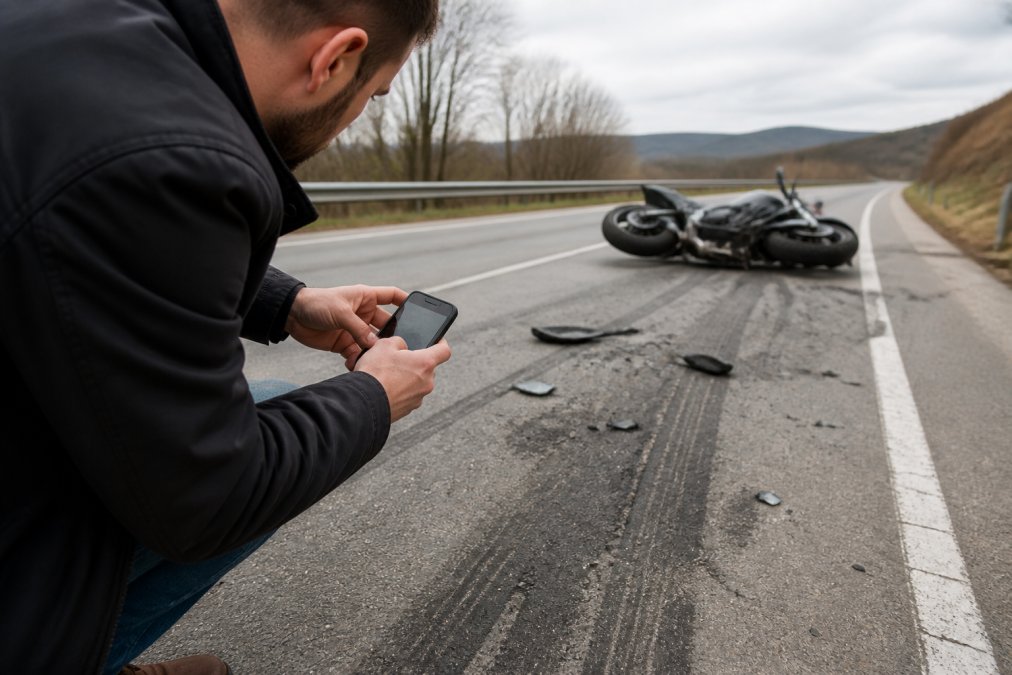
- Photos of the motorcycle, the other vehicle, and the road from multiple angles and distances
- Skid marks, debris field, and the point of impact
- The motorcycle's final resting position and any gouges in the pavement
- Names and contact info for every witness, including passengers in the other vehicle
- The other driver's insurance and plate number
- Your own injuries, photographed that day and in the days after
- The police report number and officer's name
- Your helmet, jacket, boots, and gloves, do not wash or discard them
Motorcycle-Specific Dynamics That Decide Fault
Car-accident checklists miss the physics that actually drive motorcycle fault disputes. Four dynamics come up again and again:
- Conspicuity and blind spots. A driver who says "I never saw them" is describing a failure to look, not an absence of negligence. Sight-line diagrams, sun angle, and the other vehicle's pillar and mirror geometry all matter.
- Lane position. Where the rider was in the lane, center, left third, right third, affects both visibility and who had the right of way in a merge or turn.
- Road surface hazards. Gravel, milled pavement, tar snakes, standing water, and metal expansion joints can cause a loss of traction that looks like rider error but originates with a third party's failure to maintain the roadway.
- Lane splitting and filtering. Most states do not authorize it, and the rules vary. Whether the rider was legally positioned at the moment of impact can swing a fault percentage by tens of points.
Digital Evidence: Cameras, Phone Data, and Telematics
Modern cases are often won with data, not memories. Digital evidence can prove speed, braking, and position in ways eyewitnesses cannot.
Look for:
- Nearby traffic, business, or doorbell cameras
- The other driver's phone records (via subpoena)
- Your own helmet cam, bike camera, or a passenger's phone
- Vehicle telematics and event data recorders in the other vehicle
- Rideshare or GPS app history showing route and speed
- Black box data from newer motorcycles with ride-by-wire or ABS modules
A preservation letter is not the same as a subpoena. If a custodian refuses or stalls, the footage can disappear before a lawsuit is even filed. Get counsel involved early enough to escalate.
When Liability Is Disputed: Accident Reconstruction and Biomechanical Experts
Most articles stop at "gather evidence." The harder question is what happens when the physical evidence supports two stories.
That is where expert witnesses come in:
- An accident reconstructionist uses skid length, crush damage, momentum, and scene measurements to calculate pre-impact speed, braking, and the sequence of events. Reconstruction can show, for example, that the other driver had ample stopping distance and simply failed to brake.
- A biomechanical engineer analyzes injury patterns to test whether the forces are consistent with the rider's account or the driver's. This matters when the defense argues the rider was thrown by their own speed rather than the impact.
- A human factors expert addresses perception-reaction time, conspicuity, and what a reasonable driver should have seen.
Preserving Your Own Credibility
Fault fights are also credibility fights. A rider who posts about the crash, gives a recorded statement, or delays treatment hands the adjuster ammunition. Keep a written timeline of what you remember, when you remember it, and who you spoke to. That timeline, paired with the physical and digital evidence above, is what makes a fault percentage stick.
How Insurance Adjusters and Police Reports Establish Fault
The police report is the starting point, but it is not the final word. Adjusters treat it as strong evidence, yet they build their own fault picture on top of it.
What the report typically contains:
- The officer's narrative and diagram
- Traffic citations issued at the scene
- Statements from both drivers and witnesses
- Road and weather conditions
The Statute of Limitations for Motorcycle Accidents in Tennessee
Tennessee's statute of limitations sets the deadline to file a motorcycle injury lawsuit, and missing it usually ends your case. Because the exact filing window is set by statute, confirm the current deadline with the official source or a lawyer before relying on any date.
Two practical points matter here:
- The clock generally starts on the date of the crash
- Evidence disappears long before the deadline arrives
How Fault Percentages Affect Your Compensation
Your fault percentage directly cuts your final payout. Damages are split into economic loss like medical bills, lost wages, and property damage, and non-economic damages like pain and suffering, disfigurement, and loss of enjoyment of life. Your percentage reduces the total, not just the economic piece.
The simple version looks like this:
| Your Fault % | $100,000 in Damages | You Recover |
|---|---|---|
| 0% | $100,000 | $100,000 |
| 20% | $100,000 | $80,000 |
| 40% | $100,000 | $60,000 |
| 50% or more | $100,000 | $0 |
A Multi-Party Example
Suppose a rider is struck when a pickup truck runs a red light. The rider was traveling 10 mph over the limit. A third driver, parked illegally near the corner, blocked the rider's view of cross traffic.
A jury might assign:
-
Truck driver: 65%
-
Rider: 20%
-
Parked driver: 15%
-
Rider's share of fault: 20% → $100,000 reduction
-
Recoverable from the truck driver: 65% of $500,000 = $325,000
-
Recoverable from the parked driver: 15% of $500,000 = $75,000
-
Total recovery: $400,000
Why the Order of Operations Matters
Two mechanics drive the final number, and adjusters exploit both:
- Joint and several liability versus several-only liability. In many states, a defendant who is only 10% at fault can be forced to pay the entire judgment if the other defendants are insolvent. In others, each defendant pays only their share. Which rule applies changes how aggressively each insurer settles.
- Settlement credits and setoffs. If one defendant settles for $200,000 before trial and the jury later finds total damages of $500,000 with the rider 20% at fault, the remaining defendants are typically credited with the settlement amount. The rider's net recovery can end up lower than the headline verdict suggests.
How Adjusters Use the 50% Bar Against You
- The adjuster opens with a fault split far more favorable to their insured than the evidence supports, often 50/50 or 60/40 against the rider.
- They anchor the settlement offer to that inflated percentage.
- They point to any rider conduct, no helmet, minor speeding, an expired endorsement, as proof the rider was contributorily negligent.
- They pressure for a quick settlement before the rider retains counsel or completes treatment.
A 10-point swing in fault can move a $500,000 case by $50,000. That is why fault percentage, not the size of the verdict, is usually the real battleground in a motorcycle injury claim.
This is where settlement negotiation gets aggressive. Adjusters know the 50% bar and push hard to inflate your share. The rider's job, through counsel, is to keep the percentage below 50 and to make every point of contested fault expensive for the insurer to defend.
Common Mistakes That Hurt Fault Determination in Tennessee Motorcycle Accident Cases
The biggest mistake is treating the insurance company as a neutral party. It isn't. Its job is to pay you as little as possible.
Other errors we see often:
- Giving a recorded statement before talking to a lawyer
- Posting about the crash on social media
- Skipping medical treatment, which insurers read as "not hurt"
- Waiting to preserve camera footage
- Accepting a quick settlement before your injuries are fully known
Frequently Asked Questions
Who is usually at fault in motorcycle accidents?
Common causes of motorcycle accidents include failure to yield, distracted driving, and blind spot violations by other drivers. However, fault is determined case by case using police reports, witness statements, and evidence. Even if the other driver is primarily at fault, any shared blame you carry can reduce your compensation under Tennessee's modified comparative fault rule.
How does the Tennessee modified comparative fault statute work for motorcycle accidents?
Under Tennessee's modified comparative fault system, your financial recovery is reduced by your percentage of fault. If you are found 50% or more at fault, you are barred from recovering any damages. For example, if you are 20% at fault and your total damages are $100,000, you would receive $80,000. This rule applies to motorcycle accidents just as it does to car accidents, so gathering strong evidence to minimize your fault percentage is critical.
What evidence is needed to prove fault in a motorcycle accident?
Key evidence includes the official police report, traffic citations issued at the scene, eyewitness testimony, vehicle damage analysis, and medical records. Digital evidence such as surveillance footage, helmet camera video, and phone data can also help. An attorney may work with an accident reconstruction expert to show how the crash happened. Collecting this evidence early is important because some data, like camera footage, may be overwritten or lost within days.
Can I recover damages if I am partially at fault for my motorcycle crash?
Yes, as long as you are less than 50% at fault under Tennessee's modified comparative fault rule. Your compensation is reduced by your percentage of fault. For instance, if you are 30% at fault, your award is reduced by 30%. If you are 50% or more at fault, you cannot recover anything. An experienced attorney can help challenge unfair fault assignments and present evidence to show the other driver bore most of the responsibility.